How to inspect insulating glass units properly
Under a magnifying glass, or from 20 cm away, you will find something on any pane. That is why the standard lays down exactly how an insulating glass unit is to be viewed: from 3 metres, looking through the glass, in daylight. The same rules apply to every manufacturer.
Look through the glass, not at it like a mirror
Insulating glass units are assessed to EN 1279-1, looking through the glass, not at the reflection. The rules are the same for every manufacturer:
Distance: at least 3 metres, from the inside looking out.
Angle: as perpendicular to the glass as possible.
Time: up to 1 minute per m² of glass.
Light: diffuse daylight, e.g. an overcast sky. No direct sunlight and no artificial lighting.
From the outside, the glass is assessed as installed, at the usual viewing distance and no less than 3 metres. Anything that cannot be seen this way is not regarded as a defect. Faults are not marked on the glass.
Three zones on the pane
The rules are less strict near the edge than in the middle of the pane, because the edge is less visible.
R · 15 mm along the edge, usually covered by the frame: not assessed.
E · edge zone, 50 mm wide: slightly more is allowed.
M · main zone: the strictest rules.
Spots and stains
The maximum allowed in the main zone (M) of a double-glazed unit:
| Size | Allowed |
|---|---|
| up to 1 mm | max. 3 in any area of 20 cm diameter |
| 1 to 3 mm | max. 2 in any area of 20 cm diameter |
| over 3 mm, stains over 17 mm | not accepted |
In the edge zone (E) there is no limit on spots up to 1 mm; spots of 1 to 3 mm are allowed up to 4 on a pane of up to 1 m², or 1 per metre of perimeter on larger panes.
Scratches
Fine hairline scratches are allowed, provided they do not form a cluster.
| Zone | Individual | Total |
|---|---|---|
| main zone (M) | up to 15 mm | up to 45 mm |
| edge zone (E) | up to 30 mm | up to 90 mm |
Triple glazing and laminated glass: slightly more is allowed
Every additional pane brings its own surfaces, so the number of allowable spots increases by 25% per additional glass component. For a triple-glazed unit that means ×1.25, and for a double-glazed unit made with two laminated panes, ×1.5.
These rules do not apply to patterned glass, wired glass or fire-resistant laminated glass.
Spacer
The spacer does not have to be perfectly straight. For double glazing, the tolerance on spacer straightness is 4 mm up to a length of 3.5 m, and 6 mm for longer lengths.
The distance from the glass edge, or from the second spacer in triple glazing, may deviate by 3 mm up to an edge length of 2.5 m, and by 6 mm on longer edges.
Distorted and double reflections are not defects
The panes bow in or out. An insulating glass unit holds a sealed volume of air or gas, exactly as it was on the day the unit was made. When it is colder or the air pressure is higher, the panes are drawn slightly inwards; when it is warmer, they bulge outwards. The glass then acts like a concave or convex mirror and the reflection is distorted. A larger pane deflects more than a smaller one, so each panel on a façade looks slightly different.
Double image (so-called ghosting). Every glass surface gives its own reflection, and a double-glazed unit has four. When the panes are bowed differently, the reflections do not line up and the image looks doubled. This is most visible when it is dark behind the glass.
Both are physical properties of every insulating glass unit. That is why glass is assessed by looking through it, not at the reflection.
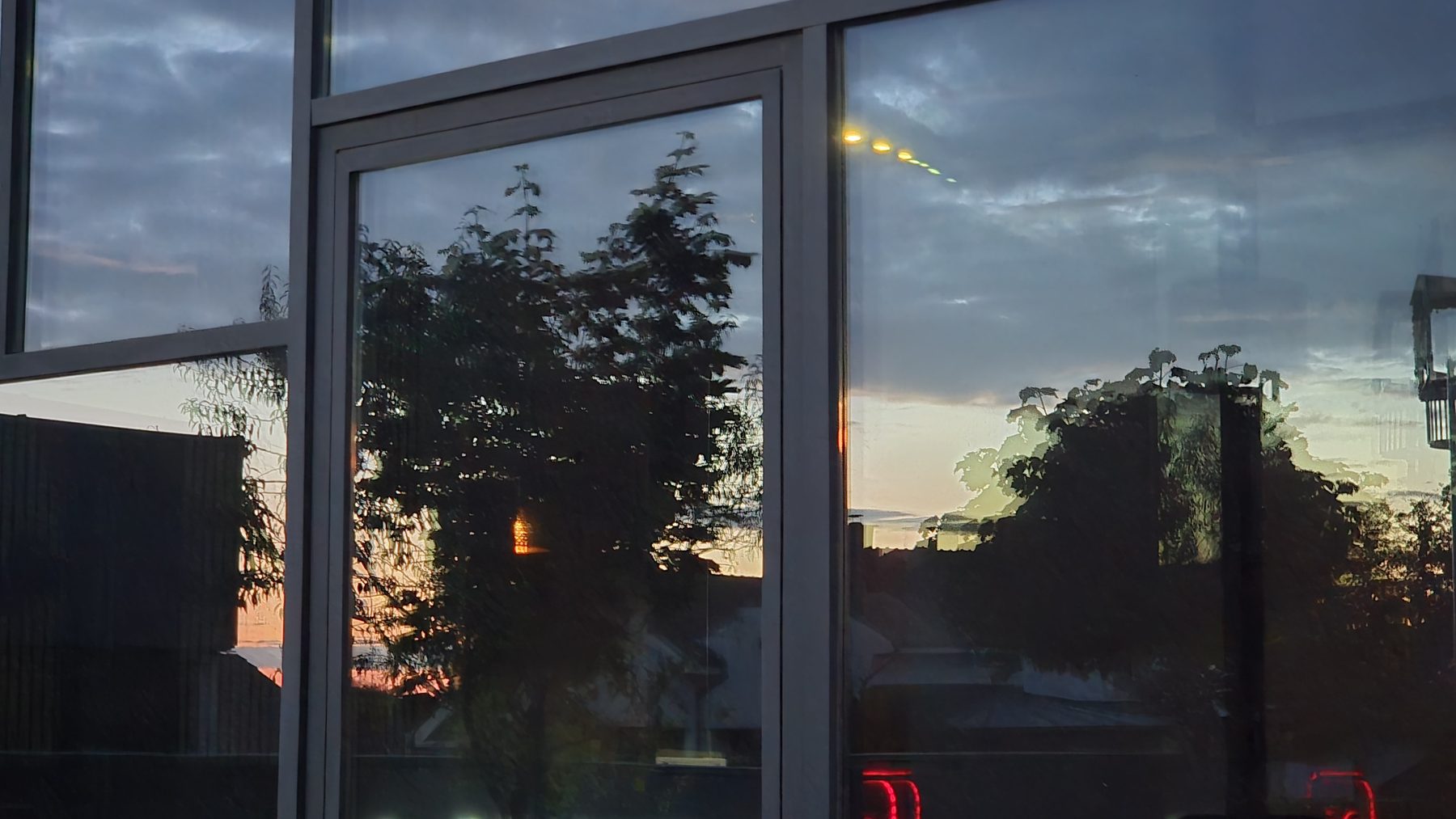
The front of our office at dusk. On the left the reflection is almost straight; on the right, in the larger pane, the tree is stretched and doubled. Same glass, same day: not a defect.
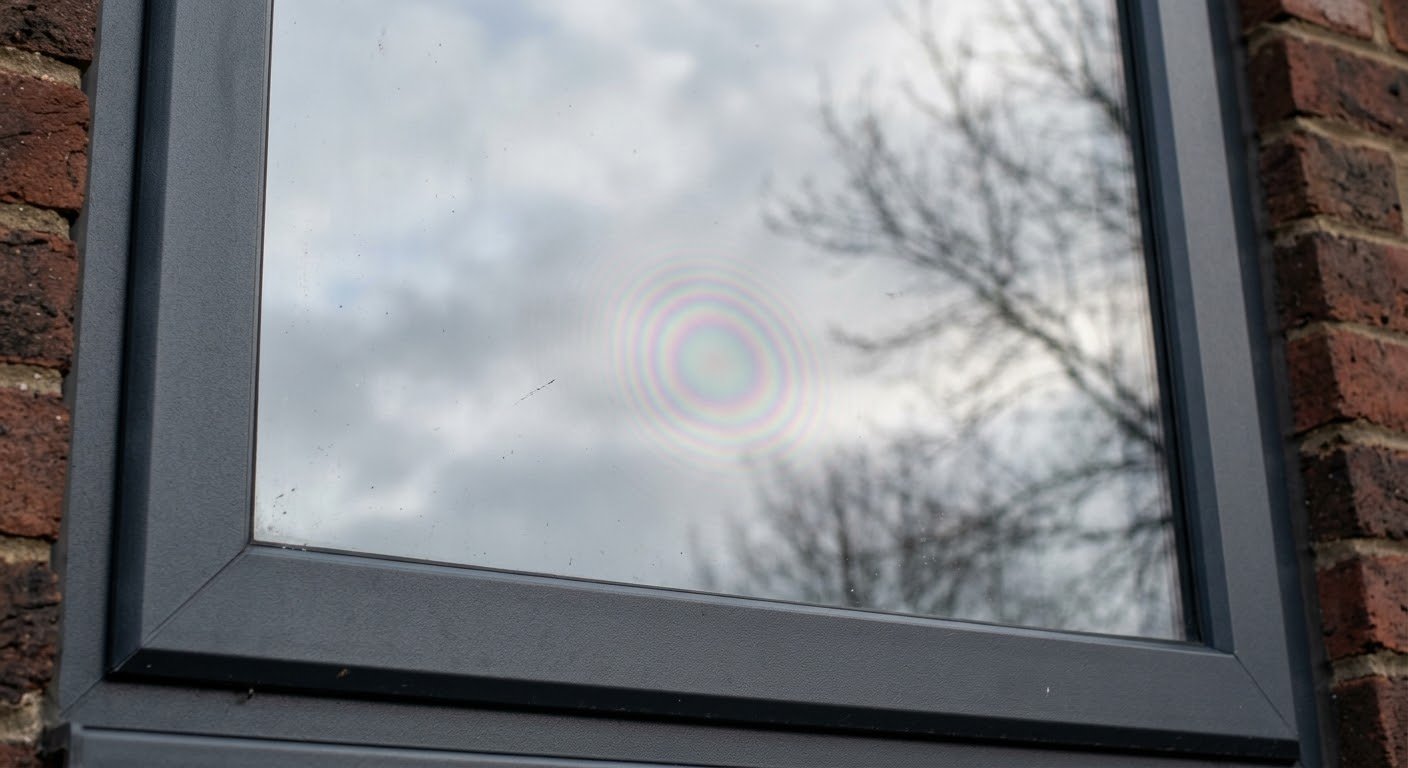
Newton rings
Rainbow-coloured spots, stripes or rings that move when you press on the glass. They are seen mainly in reflection from outside, and rarely when looking through the glass.
They occur because the panes in an insulating glass unit are perfectly flat and parallel, so light waves between them overlap. They appear only under particular lighting conditions and cannot be avoided.
This is not a defect, but proof that the glass is flat.
What else is not a defect
Shade of colour. The coating, the type and the thickness of the glass give it a slight tint. On a façade, neighbouring panes may show slightly different shades, especially when viewed at an angle.
External condensation in the morning, and marks that show when the glass gets wet (from rollers, suction cups, labels). More in the articles Three places where glass mists up and Toughened glass: roller waves and spots.
In short: from 3 metres, looking through the glass, on an overcast day. Anything that cannot be seen this way is not a defect.
Send us your opening schedule
or a project brief.
We reply with a quote and a technical data sheet, and on request a specification clause for your bill of quantities.